The Myth of the Discord "Superfan" (And How Real Community Bonds Actually Form)

When community managers picture a "superfan," they usually imagine a model digital citizen: someone exceptionally warm, eager to welcome newcomers at the door, and happy to act like an unofficial moderator by answering questions and enforcing rules.
When we looked at the data from Friendzone, that stereotype completely fell apart. This is part two of our case study on Friendzone. If you want to learn more about what makes Friendzone unique, check out part one.
Debunking the Friendly Greeter Myth
At surface level, superfans look like they chat with everyone, greet every newcomer, and radiate friendliness. But when you normalize the data per 1,000 messages sent, that illusion disappears.
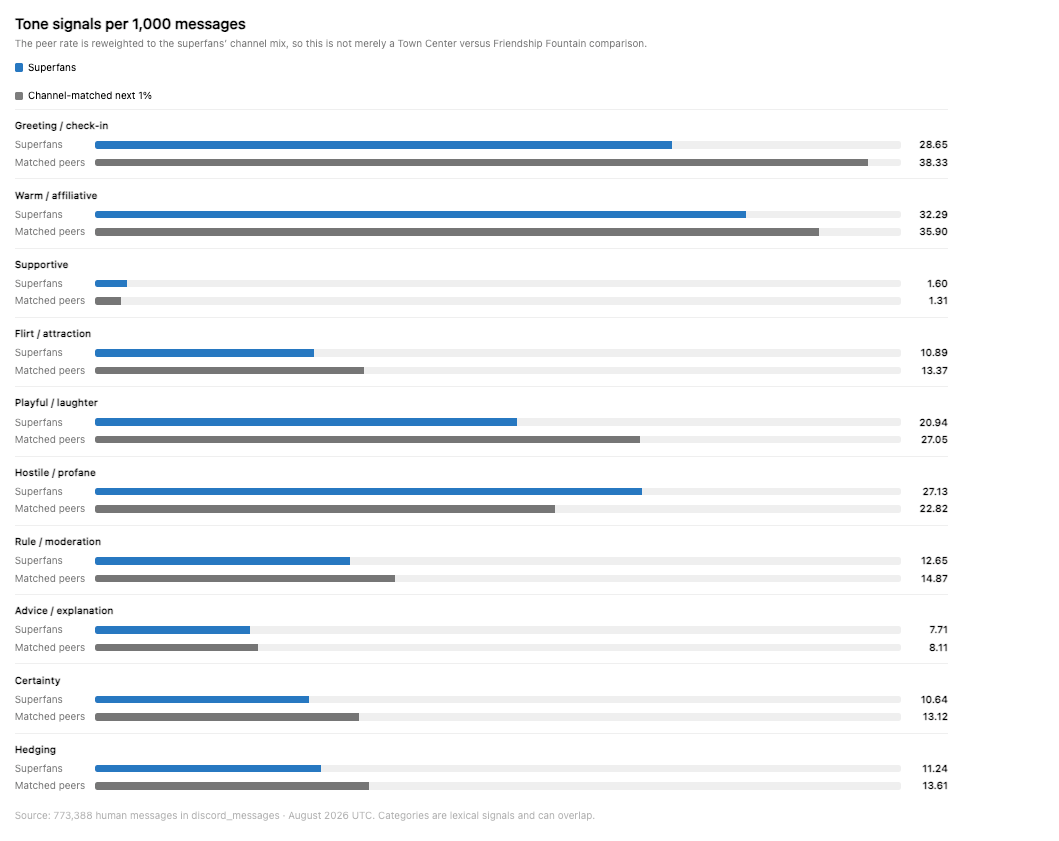
They don’t greet more newcomers. Normalized for volume, power users actually ignore welcome prompts at roughly the same rate as everyone else. They don’t act like mini-moderators. They don’t hand out server guidelines, volunteer to help lost users, or play hall monitor. They aren't extra friendly. If anything, long-time power users can lean slightly edgy or cynical. Because they know the rules intimately, they understand exactly where the line is and aren't afraid to push boundaries or banter aggressively. Superfans aren't helpful customer support agents. They are regular people who have made the server their digital third place.
The Real Metric: The "Stable Cohort" (3×)
So what actually separates a superfan from an ordinary active member?
It’s not broad outreach—it’s cohort stability.
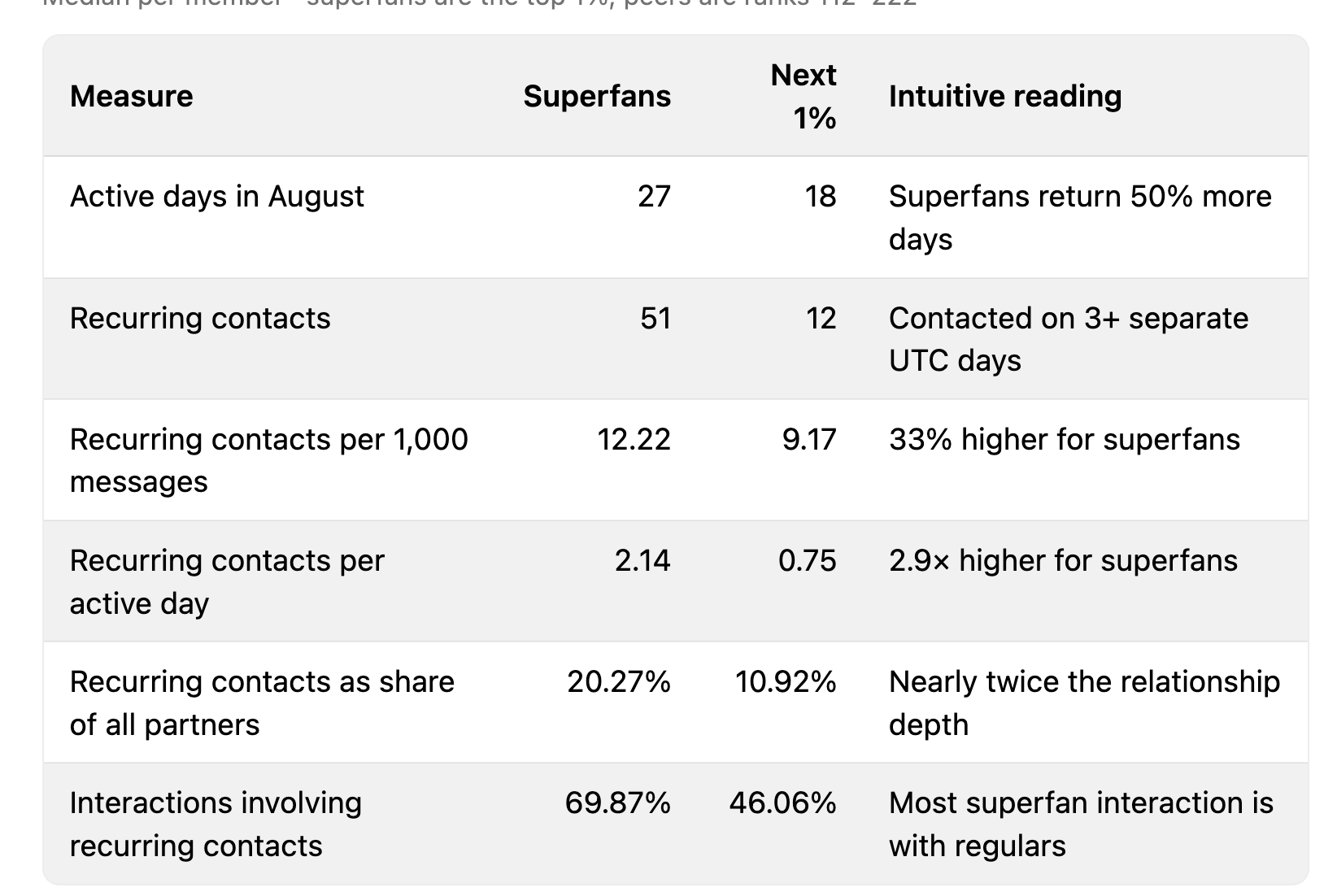
While superfans interact with a large total number of people simply by virtue of posting thousands of messages, their real engagement is anchored to a remarkably consistent inner circle:
On average, a superfan maintains multi-day interactions with 51 recurring members across three consecutive days. For a regular active user, that number drops to just 12.
Superfans aren't broadcasting to the whole server; they have developed a recurring "cast of characters." They don't just know the community—they know their slice of it.
The "After-Dinner Walk" Theory of Friendship
How does someone build a group of 50 regulars?
If you ask them, most wouldn't even say they set out to "make friends." It happens through passive, repeated familiarity.
Think of it like living in a physical neighborhood. Every evening after dinner, you take a walk around the block. You pass the same neighbor walking their dog at 7:15 PM every single night. For the first two months, you don't talk—maybe you just exchange a nod.
Eventually, because you’ve seen each other a hundred times, someone makes a comment about the weather. That leads to a casual chat about your jobs. A few months later, you’re invited over for a barbecue.
This is exactly how Discord friendships develop:
- Concurrent schedules: In a busy server, users aren't scheduling appointments. They just happen to be free at the same time of day (after work, between classes, late at night).
- Ambient co-presence: They drop messages in the main chat room at the same time. Initially, they aren't even talking directly to each other—they are talking around each other to the wider room.
- The accidental bridge: One day, User A replies to User B’s comment. Two days later, they cross paths again and pick up the thread.
- Friendship on Discord is rarely intentional; it is the natural byproduct of repeated, coincidental co-presence.
What They Actually Talk About (Hint: It’s Not Deep)
Because Discord moves in real time, the barrier to speaking has to be virtually zero. People aren't writing thoughtful essays to impress each other with their intellect.
The baseline conversation among superfans is profoundly mundane:
- What they’re eating for lunch
- The video game or anime they’re currently grinding
- Daily complaints about exams, work, or bad weather
- Casual banter, teasing, and playful flirting
In fact, a huge chunk of power-user communication isn’t words at all—it’s emojis, custom stickers, and reaction images. Daily life is inherently repetitive; emojis act as low-friction emotional shorthand that keeps ambient conversations moving without requiring a paragraph of effort.
The Transition: From Noise to Personal Continuity
How does mundane chatter ever turn into a bond that retains users for months?
It hinges on continuity and recall.
The turning point from "random chatter" to "stable cohort member" happens when one user remembers a detail about another user’s life and brings it up days later:
- Following up on someone's surgery recovery or final exam.
- Teaming up for a specific role-playing game or co-op session.
- Rallying together to report a persistent troll or spam bot.
Once someone acknowledges your personal context outside the immediate chat stream, you stop being an anonymous avatar on a screen. You become part of the group.
The Community Takeaway: Design for Co-Presence
You cannot force strangers to become friends, and trying to engineer deep bonding activities (like icebreakers or mandatory introductions) usually backfires because it violates the casual spirit of the platform.
Instead, the goal of community design is simple: engineer regular opportunities for the same people to be in the same place at the same time.
When people show up on the same schedule, bump into each other in fast-moving chat, and trade low-stakes banter day after day, the community takes care of the rest.