How Many People Use Discord? User Count, Growth, and Key Stats

When people talk about Discord’s size, the numbers can sound almost unreal.
Discord has grown from a gaming voice chat app into one of the biggest community platforms in the world. It now has hundreds of millions of registered accounts, over 200 million monthly active users cited in recent company and industry coverage, and more than 90 million daily active users listed by Discord itself.
But when I look at Discord’s growth, I do not think the most important question is only, “How many people use Discord?”
The better question is: "What are people using Discord for, and why do they keep coming back?"
That distinction matters for founders, creators, brands, and community teams. Discord’s scale is impressive, but the real opportunity is not just reach. It is participation.
Discord is not built like a normal social feed where people post, scroll, and leave. It is built around servers, channels, roles, events, voice rooms, and member-to-member interaction. That makes it one of the strongest platforms for communities that need more than announcements.
Quick Answer: How Many People Use Discord?
Discord’s user count depends on which number you are looking at.
There are a few different ways people measure Discord’s size:
Registered users
This refers to people who have created Discord accounts. This number is usually much higher because it includes anyone who signed up, even if they are not active anymore.
Monthly active users
This measures people who use Discord within a given month. Recent public references commonly place this above 200 million monthly active users.
Daily active users
This measures people who use Discord on a given day. Discord’s own company page currently lists more than 90 million daily active users.
Concurrent users
This refers to people online at the same time. For a real-time platform like Discord, this matters because voice, chat, streaming, and events often happen live.
For community builders, the most important takeaway is simple: registered users show reach, but active users show habit.
That same idea applies to individual servers too.
A server can have 50,000 members and feel quiet. Another server can have 2,000 members and feel alive every day. Size matters, but activity is what tells you whether the community is actually working.
Registered Users vs Active Users
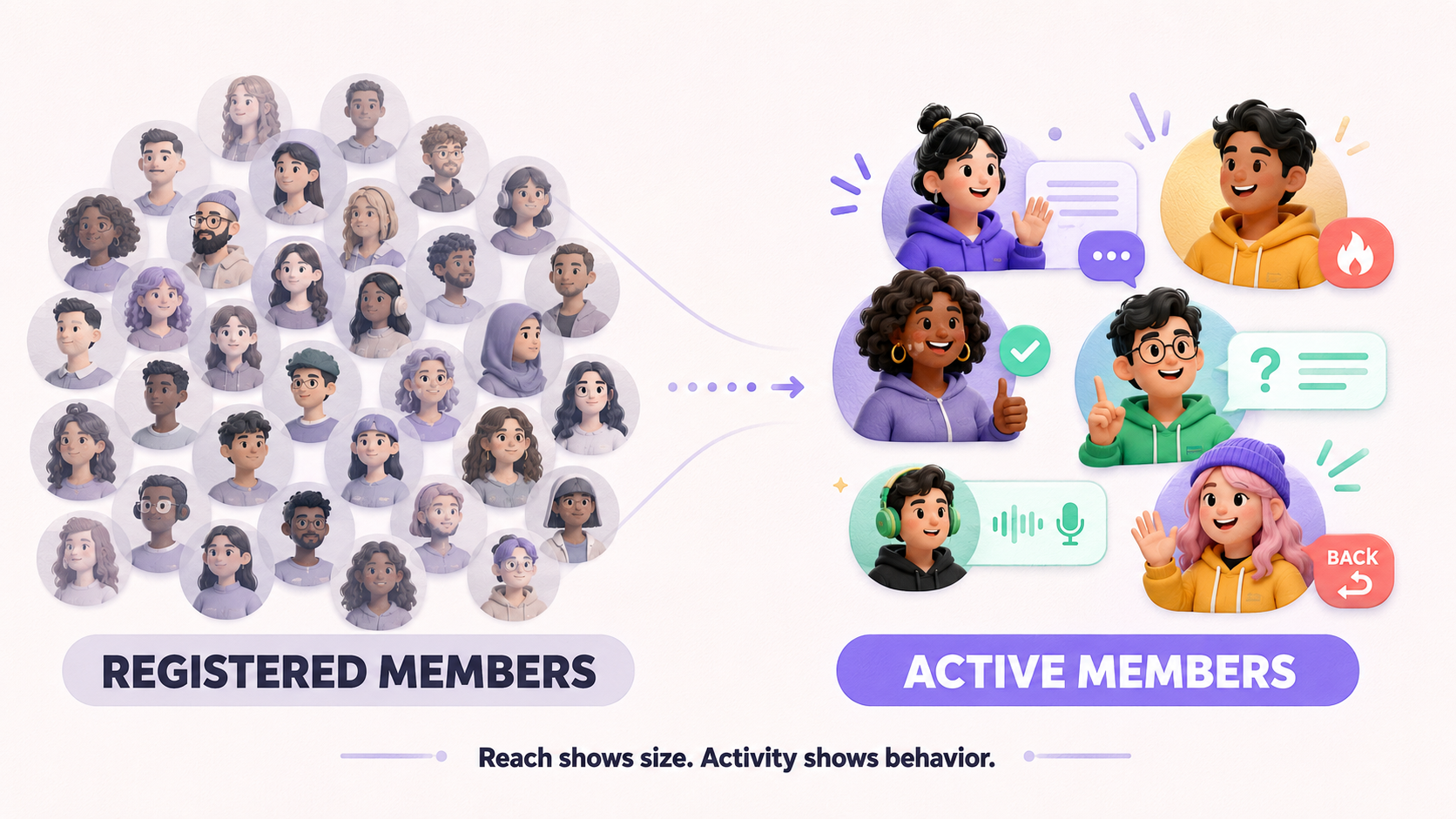
I think this is one of the most important distinctions for anyone building on Discord.
Registered users tell you how many people have entered the platform at some point. Active users tell you how many people are still showing up.
The same thing happens inside Discord servers.
A member count shows how many people joined. It does not tell you how many people read announcements, send messages, join events, ask questions, help other members, or come back next week.
That is why I would never judge a server by member count alone.
When we look at communities through CommunityOne, the better signals are usually things like:
- How many members are active this week
- Which channels are actually creating conversation
- Whether new members send a first message
- Whether people return after joining
- Which announcements or events create real engagement
- Whether activity is coming from the whole community or only staff
- Whether growth is improving retention or just increasing the member count
Registered users are a reach metric. Active users are a behavior metric. For community teams, behavior is where the real insight is.
When Was Discord Released?
Discord launched publicly in 2015.
Its original use case was simple: give gamers a faster and easier way to talk while playing. At the time, many players were using clunky voice tools, scattered group chats, or forums that did not feel built for live coordination.
Discord solved that problem well.
But its growth did not stop with gaming. Over time, Discord became useful for creators, study groups, developer communities, Web3 projects, support communities, fan spaces, and brands.
That shift is important.
Discord did not grow because it became another social media feed. It grew because it gave communities a structure. Servers became places with rooms, roles, rules, events, rituals, and shared identity.
That is what makes Discord different.
Why Discord Keeps Growing
Discord’s growth makes more sense when you understand how people actually use it.
Most platforms are built around broadcasting. You post something, people react, and the conversation moves on.
Discord is different because it is built around belonging.
People join servers because of a game, creator, project, brand, friend group, or shared interest. Once they are inside, the experience can become part of their routine.
There are a few reasons Discord keeps growing:
Joining is easy.
A single invite link can bring someone into a server from Twitter, YouTube, TikTok, a website, a game, or a friend.
People can belong to many servers.
One person might be in a gaming server, a creator community, a work group, a product support server, and a private friend group at the same time.
Servers create habits.
Daily check-ins, recurring events, voice hangouts, announcements, quests, support threads, and member conversations all give people reasons to return.
Community structure is flexible.
Channels, roles, permissions, bots, forums, and events let each server design its own flow.
This is why Discord is powerful for community building. It is not just where people gather. It is where communities can operate.
How Many Discord Servers Are There?
Discord has millions of servers across different use cases but I do not think the total number of servers is the most useful thing to focus on. The more useful question is: what kind of server are you building?
Most Discord servers fall into a few broad groups:
Private servers
These are smaller spaces for friends, classmates, teams, or private groups.
Community servers
These are structured around a topic, project, game, interest, or audience.
Creator servers
These help creators bring their audience into a more interactive space.
Brand or product servers
These are used for support, announcements, feedback, customer community, or education.
Web3 and gaming servers
These often combine announcements, support, events, quests, moderation, and community-led discussion.
Each type of server has a different growth problem.
A creator server might need better onboarding. A product server might need better support flow. A Web3 server might need better moderation and trust. A gaming server might need events and retention loops.
This is why copying another server’s structure rarely works perfectly. The server needs to match the behavior you want to create.
Who Uses Discord?
Discord still has a strong association with younger users and gaming communities, but the platform is much broader now.
The average Discord user depends heavily on the server.
A student community will behave differently from a developer hub. A gaming server will not look like a customer support server. A creator fan community will not have the same rhythm as a DAO or brand community.
That said, Discord users usually share one important pattern:
They join because of an interest, not because they want to build a public profile.
That makes Discord different from platforms like Instagram, TikTok, or X. On those platforms, identity is often built around posting and visibility. On Discord, identity is often built around participation.
People are not only watching. They are joining spaces, asking questions, reacting to updates, joining voice rooms, collecting roles, and becoming part of a group.
For community builders, that is the opportunity.
Discord Is Not Just an Audience Platform
This is something I think more brands and founders need to understand.
A Discord server is not just a place to repost announcements.
If your Discord is only a one-way broadcast channel, members may join once and slowly disappear. They can already get updates from your website, newsletter, or social media. The reason to join Discord should be different.
A strong Discord gives members something they cannot get from a feed.
That might be:
- Faster access to updates
- Direct access to the team
- Community discussions
- Events and live sessions
- Support from other members
- Roles and recognition
- Early feedback opportunities
- A sense of belonging
This is why community health matters more than raw member count.
If members do not have a reason to participate, the server becomes a quiet announcement board.
How Discord Makes Money
Discord is free to use, but its business model is not built around traditional social media ads.
Instead, Discord has historically focused on premium features and community upgrades.
The most familiar examples are:
Nitro subscriptions
Nitro gives users perks like larger uploads, higher-quality streaming, custom emoji use across servers, profile customization, and other premium features.
Server boosts
Boosts let members support a server and unlock community perks.
Commerce and paid community features
Discord has also experimented with more tools for community monetization and commerce over time.
For community teams, the interesting part is that Discord’s monetization is connected to experience. People pay to improve how they use Discord or support the spaces they care about.
That says a lot about why the platform works. The value is not only in content. It is in the community environment.
How Much Is Discord Worth?
Because Discord is still a private company, its valuation is not as straightforward as a public company’s market cap.
You may see different numbers in funding coverage, private market discussions, or IPO-related reporting. Those numbers can change depending on market conditions, investor demand, revenue growth, and whether Discord moves forward with a public listing.
So I would avoid treating any single valuation number as permanent.
If you are using Discord stats in a pitch deck, strategy doc, or market research post, use a dated source and make it clear whether the number is official, estimated, or reported.
For most community builders, Discord’s exact valuation is less important than what the platform’s growth tells us:
Community-led spaces are not a niche behavior anymore.
They are part of how people learn, play, buy, support, and belong online.
What Discord’s Scale Means for Community Builders
Discord’s size is impressive, but it does not guarantee that every server will grow.
This is where a lot of communities get stuck.
They assume that because Discord has a huge user base, launching a server should be enough. But a server does not grow just because it exists.
People need a reason to join. Then they need a reason to stay. Then they need a reason to return. For me, that is the real community-building work.
A healthy Discord usually needs:
Clear positioning
Members should understand what the server is for as soon as they enter.
Good onboarding
New members should know where to start, what to read, and how to participate.
Strong channel structure
Too many channels can make the server confusing. Too few can make it hard for conversations to find the right place.
Consistent programming
Events, prompts, AMAs, quests, office hours, and recurring discussions help create rhythm.
Active moderation
Rules need to protect the culture without making the server feel overcontrolled.
Member-led participation
The healthiest communities do not depend only on staff to keep every conversation alive.
This is why CommunityOne focuses so much on activity, retention, and channel behavior. Those signals tell you whether your community is becoming part of someone’s routine.
Discord vs Telegram: Why the Difference Matters
Discord and Telegram often get compared because both can host large groups and communities.
But they are not built for the exact same behavior.
Telegram is strong for fast distribution. It works well for announcements, mobile-first updates, and simpler group communication.
Discord is stronger when you need structure.
A Discord server can have separate rooms for onboarding, support, feedback, events, announcements, resources, and casual discussion. Roles and permissions let you shape the member journey. Voice channels and events make it easier to create live interaction.
So the choice depends on what you need.
If your goal is fast broadcast, Telegram can work well.
If your goal is a structured community with multiple spaces and member interaction, Discord is usually the stronger fit.
If you want to weigh Discord against non-chat platform types too, see our guide to the best Discord alternatives for creators, brands, and communities.
What a Thriving Discord Looks Like
A thriving Discord is not just a server with a large number beside its name.
It usually has a few signs:
- New members know what to do first
- People talk without waiting for staff to start every conversation
- Members answer each other’s questions
- Announcements create discussion, not just passive views
- Events bring people back into the server
- Roles create identity or progression
- Moderation feels consistent
- The server has a rhythm members understand
At larger scales, this becomes even more important.
A 30,000-member server does not stay healthy by accident. It needs systems for onboarding, moderation, channel design, content cadence, and member activation.
That is why the best communities are not only grown. They are operated.
How to Build a Discord Community That Keeps People Around
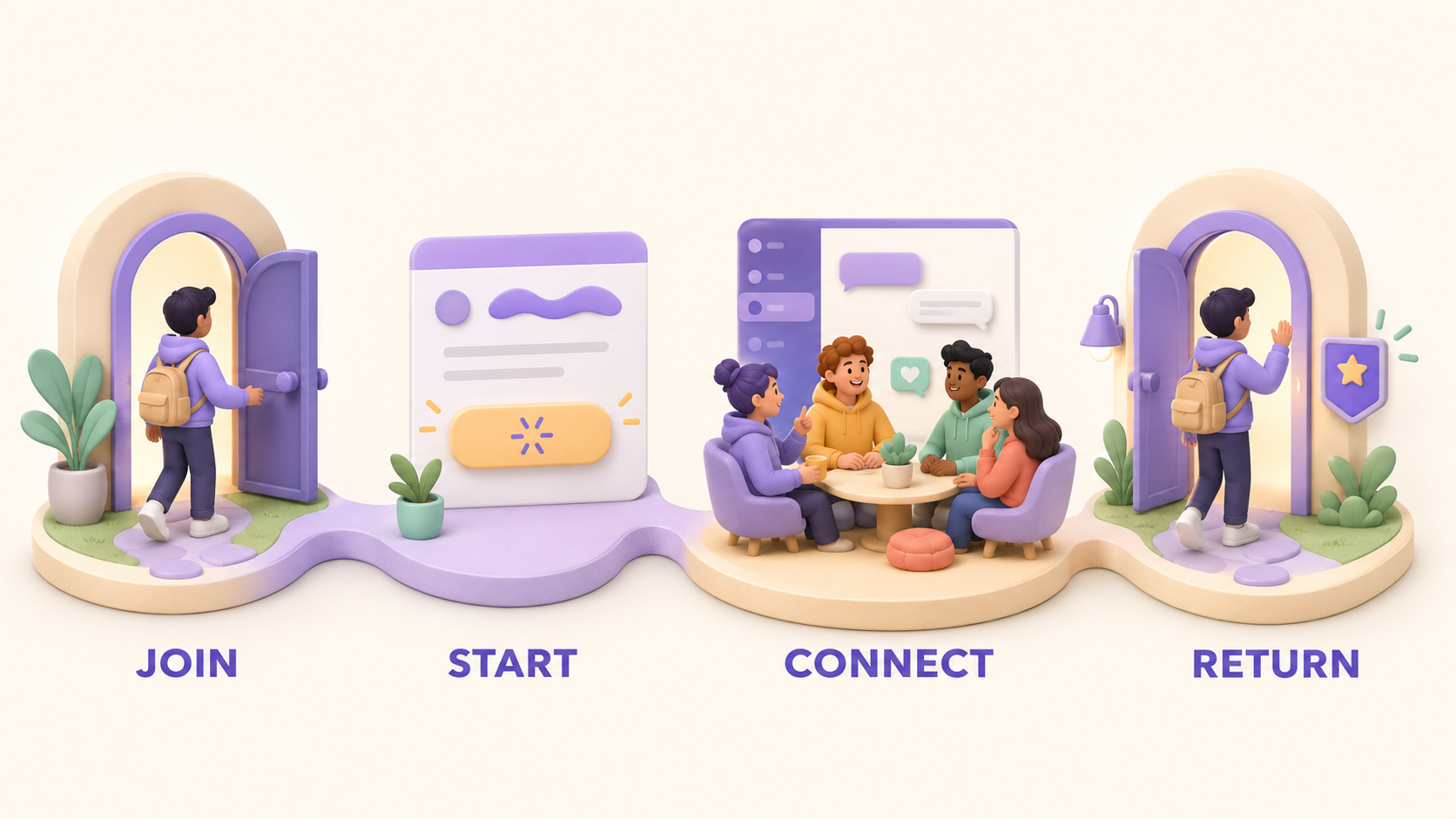
If you are starting or improving a Discord server, I would focus less on “How do we get more members?” and more on “What happens after someone joins?”
Here is the basic flow I would check:
1. Can new members understand the server quickly?
Your welcome area should explain what the community is, who it is for, and where to go first.
2. Is there an easy first action?
This could be an intro prompt, role selection, question thread, event RSVP, or starter channel.
3. Are there reasons to return?
Recurring discussions, updates, AMAs, office hours, game nights, and weekly prompts help create habit.
4. Are the right channels active?
Activity in random chat is fine, but your most important channels should also show signs of life.
5. Are members connecting with each other?
A community becomes stronger when value does not only come from the team.
6. Are you tracking what works?
Without analytics, it is easy to mistake noise for growth.
This is where CommunityOne can help. Instead of guessing which parts of your server are working, you can track activity, growth, retention, and channel performance over time.
The CommunityOne View: Discord Scale Is Only Useful If You Understand Behavior
Discord has massive reach, but server success still comes down to behavior.
How many people joined?
How many stayed?
Where did they participate?
Which channels helped them feel included?
Which events created real activity?
Which updates brought people back?
Which parts of the server are quiet?
These are the questions that matter once your server is live.
Member count is useful, but it is only the surface. The deeper value comes from understanding how people move through your community and where they find reasons to participate.
That is the difference between having a Discord server and building a Discord community.
FAQ: Discord User Count and Growth
How many people use Discord?
Discord has over 90 million daily active users according to its company page, and recent public company materials and reporting cite over 200 million monthly active users.
How many registered users does Discord have?
Discord has been widely reported as having hundreds of millions of registered accounts. Registered accounts are different from active users because they include people who may no longer use the platform regularly.
When was Discord launched?
Discord launched publicly in 2015. It started with a strong gaming use case, then expanded into broader communities, creators, brands, education, Web3, support, and interest-based spaces.
How many Discord servers are there?
Discord has millions of servers across private groups, public communities, creator spaces, product communities, gaming servers, and brand communities. The exact number changes over time, but the more useful question is whether a server is active, structured, and well-run.
Is Discord only for gamers?
No. Gaming is still a major part of Discord’s identity, but the platform is now used by creators, brands, students, developers, Web3 projects, support teams, hobby groups, and many other communities.
How does Discord make money?
Discord mainly makes money through paid features like Nitro subscriptions, server boosts, and other premium or commerce-related offerings.
Is Discord better than Telegram for communities?
It depends on the use case. Telegram is strong for fast broadcast and lightweight group communication. Discord is stronger for structured communities with channels, roles, permissions, events, support spaces, and deeper member interaction.
Final Takeaway
Discord’s user count is massive, but that is not the most important lesson for community builders.
The real lesson is that people want spaces where they can belong, participate, and return.
Discord works because it gives communities structure. Servers are not just chat rooms. They can become event spaces, support hubs, knowledge bases, feedback loops, and social environments.
But a server does not become healthy just because people join.
You need onboarding, structure, programming, moderation, and a clear reason for members to keep coming back.
That is why the best Discord communities do not only track member count. They track activity, retention, participation, and behavior.
Because growth tells you people found the door.
Community health tells you whether they stayed.

Discord’s scale is huge, but your server’s success depends on what members do after they join.
CommunityOne Analytics helps you track growth, activity, retention, and channel performance so you can understand what is actually working inside your community.