How to Grow a Discord Server from 0 to 1,000 Members in 2026

Getting your first 1,000 Discord members is the hardest milestone in server growth. Below 100 members, the server feels empty. Between 100 and 500, you're fighting to build consistent activity. At 1,000, something clicks: conversations start on their own, members bring friends, and the community becomes self-sustaining.
This guide covers the tactics that actually work in 2026. Some strategies that dominated a few years ago, mass invite links, bot-farmed member counts, are now actively penalized by Discord's algorithm and by community listing sites. What works now is slower, but the members you get are real and engaged.
We tracked servers from zero to 1,000 members between January and May 2026, across gaming, anime, crypto, study groups, and creator communities. Here's what actually worked, ranked by how efficiently each tactic produced real, retained members.

Hitting 1,000 members is a milestone. What happens after is the real test.
CommunityOne tracks activity, retention, and channel performance so you can see whether your new members are actually sticking around, not just inflating the count.
Step 1: Nail Your Server Structure Before You Promote
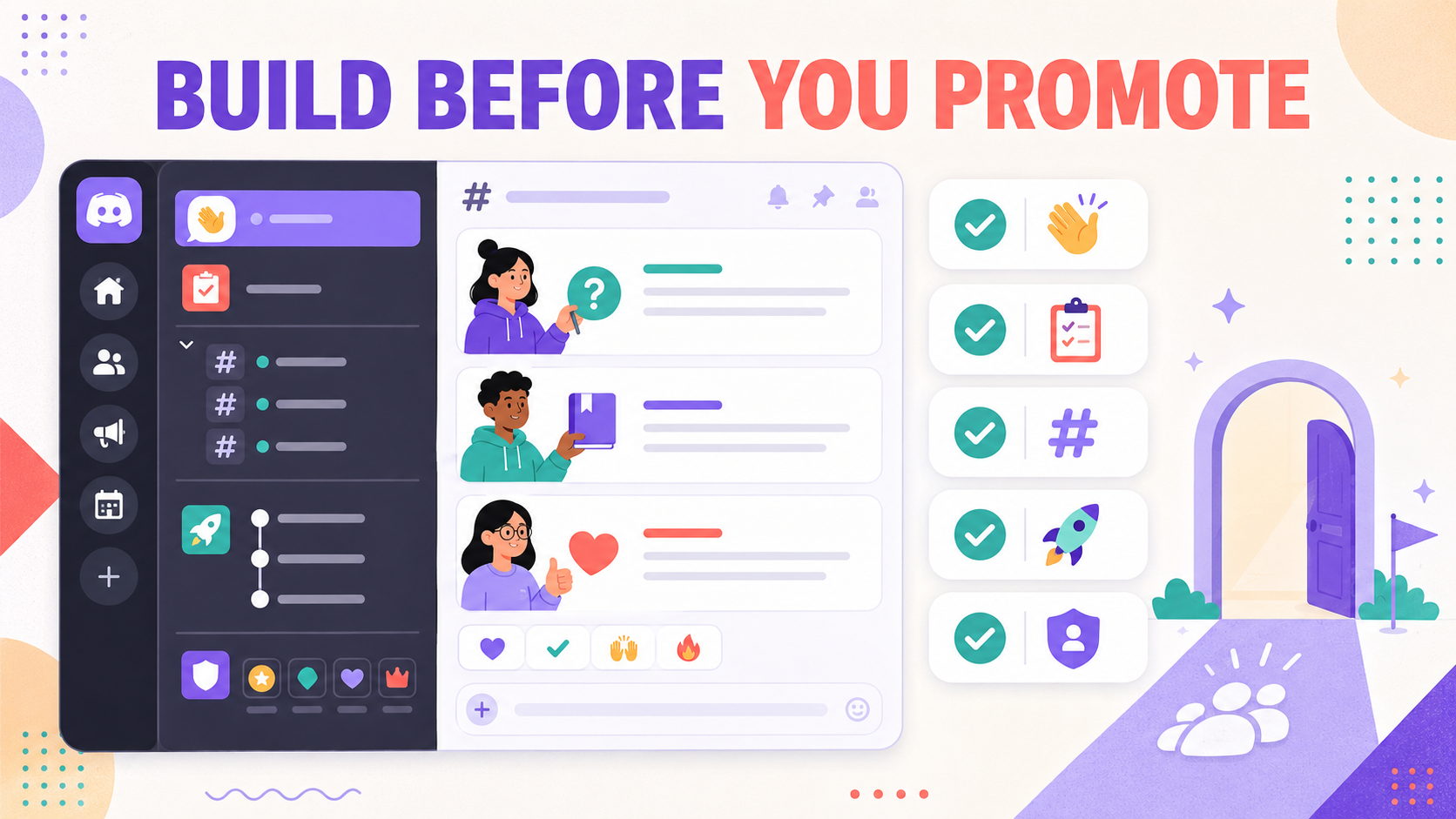
The single biggest mistake new server owners make is promoting before the server is ready. If someone joins and sees empty channels, no pinned rules, and zero activity, they leave in under 60 seconds, and Discord's algorithm notices the bounce rate.
Before driving any traffic, make sure you have a clear welcome channel with rules and a description of what the server is about, at least 3 to 5 active channels with recent messages (even if it's just you posting), a visible onboarding flow using Discord's built-in onboarding wizard under Server Settings > Onboarding, and role assignments so members feel like they belong to something specific. It also helps to have a trusted person or two ready to moderate. Our guide to building a mod team covers how to find and train them even at this early stage.
Spend a week seeding content before inviting anyone. Post questions, share resources, and create the appearance of activity. The first 20 to 30 people who join determine the culture of your server.
Step 2: List on Discord Discovery Sites
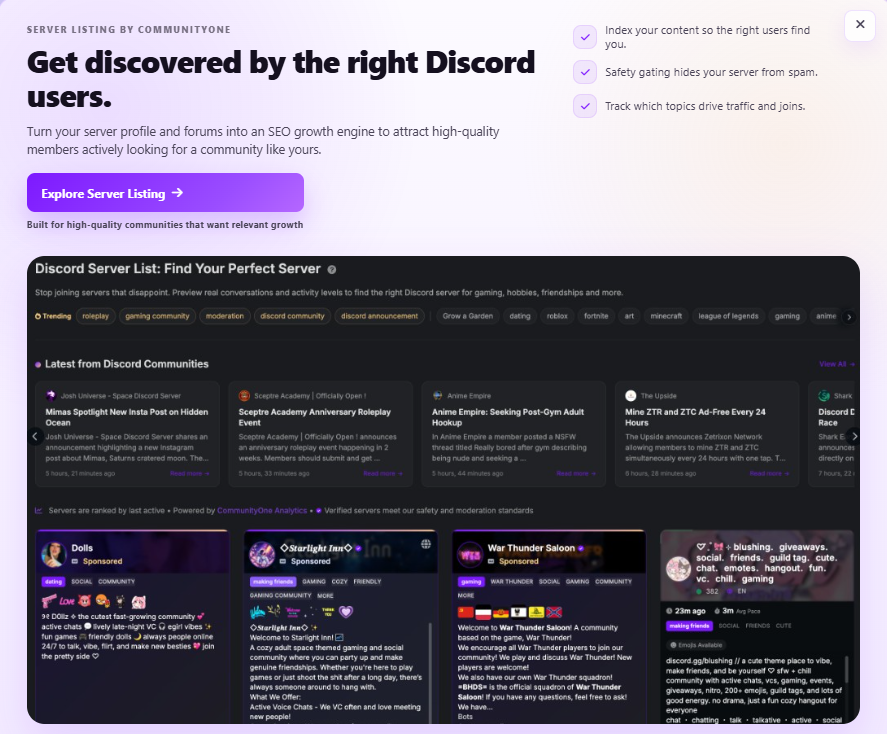
Sites like CommunityOne, Disboard, Discord.me, and Discord's own Server Discovery tab bring in members who are actively searching for a new community, not just people who stumbled across an invite link. Discord Discovery has follower and activity minimums before a server qualifies, but third-party sites like Disboard let you bump your listing every few hours for free, which matters more than it sounds like early on. Worth knowing going in: these listing sites are historically pay-to-play and attract a fair number of members with NSFW intentions, so don't expect every join to be a great fit. If you bump consistently, though, you'll see a substantial number of members over months.
Treat your listing like a landing page. Lead with what the server is about and who it's for, not a wall of emoji and vague adjectives. If you have any ad budget at all, our guide to growing a Discord server covers which channels are worth testing at this stage and which ones waste money.
Step 3: Get Your Content Indexed by Google
Beyond bumping listing sites, it helps to get your best threads and announcements indexed where people are already searching. CommunityOne can index your high-quality threads and announcements on Google and other platforms, so when someone asks AI or Google about a topic your server covers, your content shows up. It's a slower channel than a giveaway spike, but it's one of the most sustainable ways to bring in members over time.
Step 4: Cross-Post on Reddit
Most niches have a subreddit, and most subreddit rules allow a Discord link in a post as long as you're not spamming it daily. Find the 2 to 3 subreddits that overlap with your server's topic, read the rules on self-promotion, and post something with actual value, a resource, a build, a piece of writing, not just "join my server."
The invite works best in a comment or a flair rather than the post title. Reddit's algorithm and its users both tend to penalize posts that read as an ad, so let the content stand on its own and mention the server as a secondary detail.
Step 5: Run Giveaways Strategically
Giveaways bring in a spike of joins, but a spike is all you get unless the mechanics are built to keep people around. Requiring entrants to stay in the server for a set number of days before the drawing, rather than joining and leaving immediately, cuts the post-giveaway member drop significantly. A common approach: require entrants to join and reach a certain level via a leveling bot like Arcane or Mee6 before they can enter the raffle.
Bots make this easy to enforce. Our roundup of best Discord bots covers a few built specifically for giveaway management, including ones that auto-verify entry requirements and re-roll winners who've already left.
Step 6: Activate Your Existing Audience
If you already have any kind of following, a YouTube channel, a Twitch stream, a newsletter, a TikTok, that audience is your fastest and cheapest source of members. A pinned link in a video description or a mention at the end of a stream will consistently outperform cold discovery methods.
This works both ways. If you're building an audience alongside your server, our guide to growing a YouTube channel covers how the two feed each other once you have even a small community to point new viewers toward.
Step 7: Partner With Similar-Sized Servers
Server owners at a similar size to yours are usually more open to cross-promotion than the biggest servers in your niche, who have little incentive to share their audience. Reach out directly, propose a mutual shoutout in an announcements channel or a shared event, and keep the ask specific instead of a generic "let's promote each other."
The best partnerships are with servers that are adjacent but not directly competing, so members joining from the partner server actually find something new rather than a duplicate of what they already have.
Step 8: Keep the Members You Already Have
Growth without retention just refills a leaky bucket. The single best predictor of whether a new member sticks around is whether they post or react within their first 24 hours, so make that easy: a simple intro channel, a low-effort reaction poll, anything that gets a first action logged quickly.
Track this over time rather than just watching the total member count climb. Our breakdown of member count trends covers which numbers actually indicate a healthy server versus ones that look good on the surface but hide a shrinking active base.
Reading Your Engagement Data
Member count on its own tells you almost nothing about whether a server is healthy. Two servers can both hit 1,000 members and be in completely different shape, one full of people actively talking to each other, the other a graveyard of accounts that joined once and never came back. Your analytics dashboard has a few metrics that separate the two.
- 7-day chat retention. The percentage of members still chatting a week after their first message. This is the clearest signal of whether your first-24-hours structure from Step 1 is actually working. If new members send one message and vanish, fix the welcome flow before spending more effort on acquisition.
- Engagement quality score. Measures the depth of conversations, not just how many messages get sent, scoring chat anywhere from shallow to deep. Rising message volume with a flat or falling quality score usually means giveaway spam or bot chatter, not real growth.
- Average social reach. How many different people the average member talks to per day. This should climb as you grow, since new members are cross-pollinating across channels. If it stays flat while your member count rises, you're adding people to a room where they only ever talk to the same few friends.
Watch these alongside your growth curve, not instead of it. A server can cross 1,000 members and still be hollow if nobody in it is actually talking to anyone.
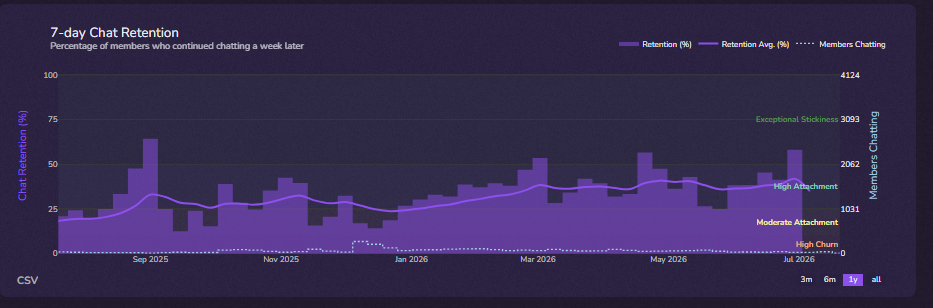
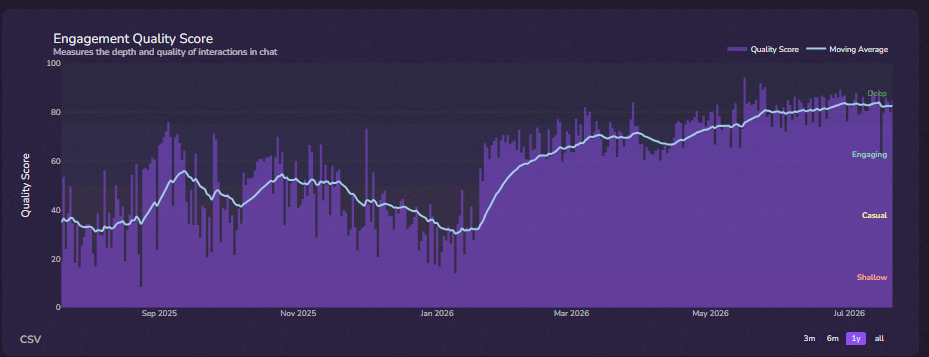
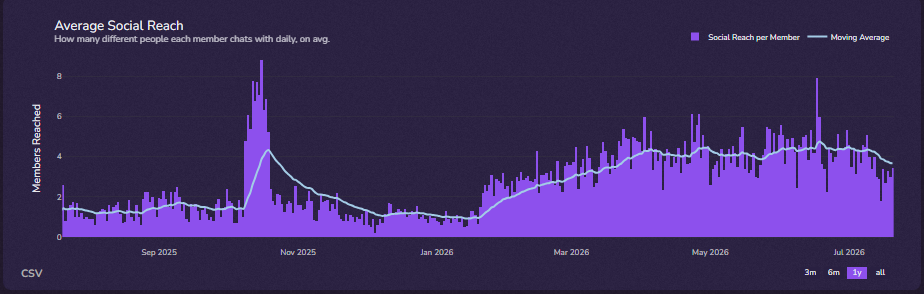
These are just three of the metrics available. CommunityOne Analytics tracks these and more, giving you a full picture of how your server is actually engaging.
A Realistic Timeline
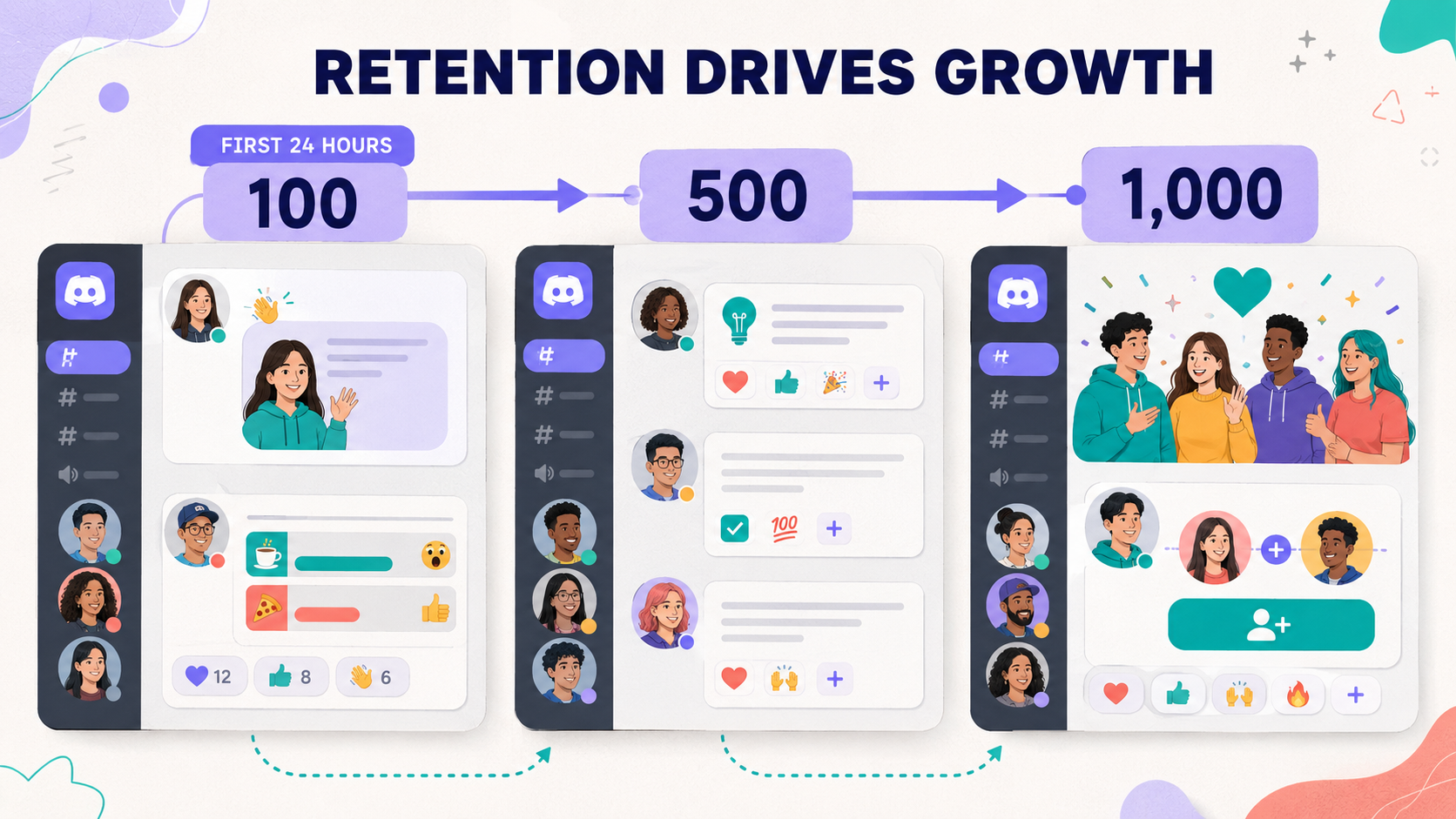
Growth isn't linear, and most servers hit 1,000 members in stages rather than a steady climb. Based on the servers we tracked:
- Week 1 to 2: seeding content and setting up structure, close to zero external members yet.
- Month 1: first 100 to 200 members, mostly from discovery sites, Reddit, and your existing audience.
- Month 2 to 3: 300 to 600 members, as discovery listings gain traction and word of mouth starts contributing.
- Month 4 to 6: crossing 1,000, driven mostly by partnerships, giveaways, and retained members bringing friends.
Final Thoughts
None of these tactics work in isolation. The servers in our data that hit 1,000 members fastest combined at least four of the eight strategies above, structure first, then discovery listings, search visibility, audience activation, and partnerships running in parallel. Pick the ones that fit your niche and the audience you already have, and treat the first 1,000 as a floor to build retention habits on, not a finish line.